


Emergy Analysis Based Method for Site Selection of Photovoltaic Plants
-
摘要:
为合理指导光伏电站的有序规划及可持续开发,提出一种以能值分析为基础的光伏电站选址及生态经济收益评估方法. 通过能值分析与地理信息系统(GIS)空间分析相结合,对内蒙古12个盟市地区光伏发电可利用土地生态经济收益情况做出分析. 分析结果表明:呼和浩特、包头等内蒙古中西部城镇密集地区体现出更为优异的可开发价值,而经过对比发现由输电距离所导致的输电损失占据了各项能值投入中的决定性比重;此外,对于绝大部分可利用地块而言,与城镇或建成环境越近,其生态经济收益也相对越高,而在能源结构转型的过程中,光伏土地占用与不断扩张的城市建设用地需求,或将成为未来城市规划与光伏能源规划所面临的首要矛盾.
Abstract:Following the guideline of the reasonable planning and sustainable development of photovoltaic (PV) power plants, an emergy analysis based method is proposed for the site selection and eco-economic benefit assessment of PV power plants. Through the combination of emergy analysis and geographic information system (GIS) spatial analysis, the eco-economic benefits of land available for PV generation in 12 league cities of Inner Mongolia China are analyzed. The result shows that: Hohhot, Baotou and other densely populated areas in central and western Inner Mongolia show more excellent development value. Through comparison, it is found that the transmission loss caused by transmission distance accounts for a decisive proportion of all emergy inputs. In addition, for most of available land plots, the eco-economic benefits are relatively higher when they are close to urban towns or built environment. In the process of structural transformation of energy, the occupation of PV land and the expanding demand for urban construction land may become the primary imbalance between urban planning and PV energy planning in the future.
-

图 2不同研究中光伏选址决策权重对比
Figure 2.Comparison of decision weights in PV site selection in different studies
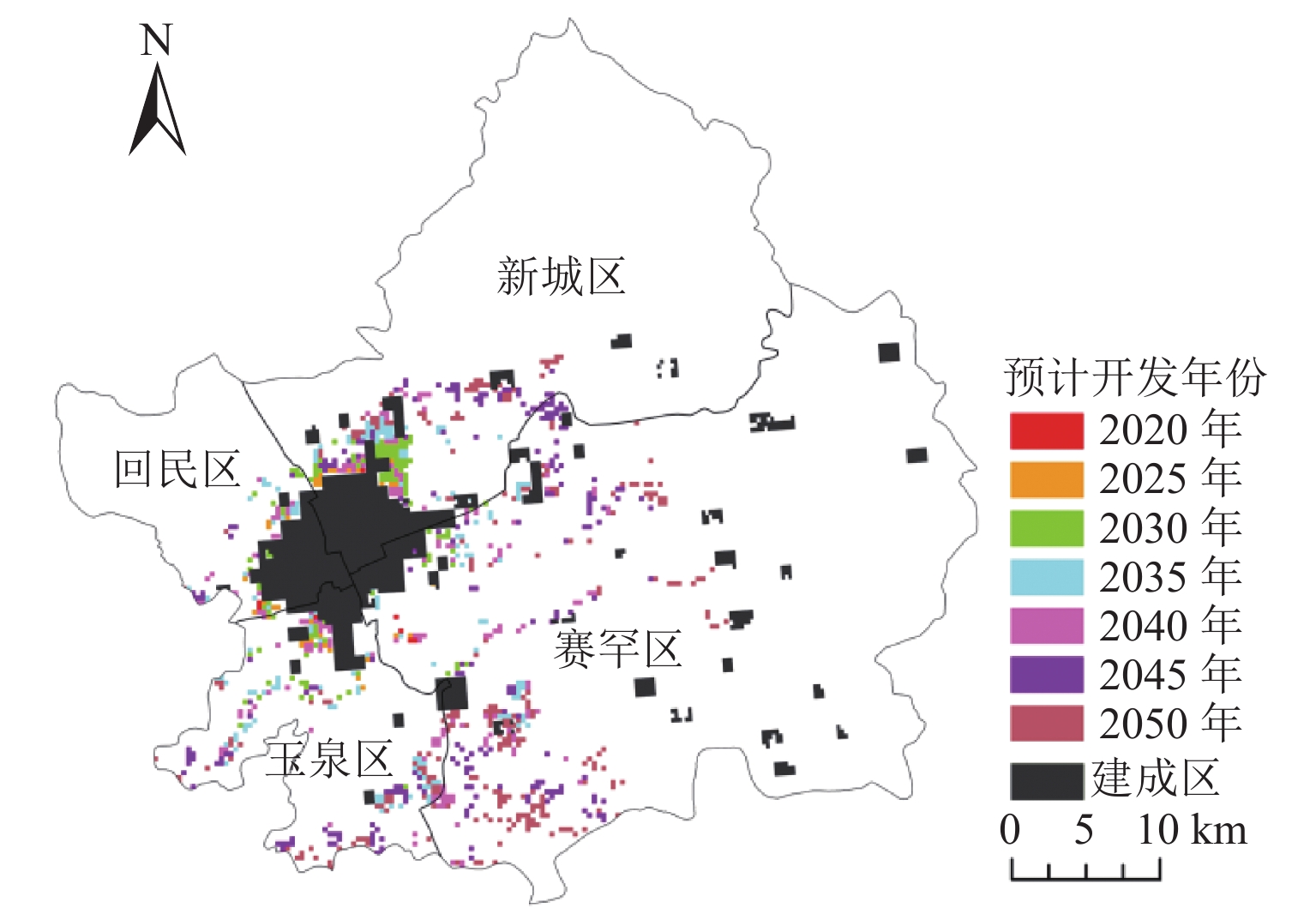
图 3呼和浩特市2020年—2050年光伏用地发展预测
Figure 3.Prospect of PV land development in Hohhot from 2020 to 2050
表 1本文估量化方法
Table 1.Methods for evaluation used in this study
量化类项 量化公式或取值方法 年电力能值产出/(sej·年−1) ${ {E} }_{ {{\rm{t}}} }={E}{ {V} }_{ {{\rm{e}}} }$ 光伏阵列间距/mm D,文献[36] 光伏安装面积/m2 ${ {S}={A} }_{ {{\rm{pi}}} }{L}/{D}$ 光伏装机容量/W ${ {C}={C} }_{ {{\rm{p}}} }{S}/{ {A} }_{ {{\rm{p}}} }$ 年光伏发电量/(kW·h) ${E}={S}{ {G} }_{ {{\rm{ti}}} }{j}{K}$ 电站第i项物质投入/(g·m−2) Mi,据文献[20]折算 第i项物质能值转换率/
(sej·g−1)Vi 电站建设能值投入/
(sej·年−1)${ {E} }_{ { {\rm{s} } } }={S}(1.02{ {\displaystyle\sum } }_{ {i}=1}^{ {n} }{ {M} }_{ {i} }{ {V} }_{ {i} } + { {C} }_{ { {\rm{L} } } }{ {V} }_{ { {\rm{L} } } })$ 道路建设能值投入/sej ${ { {E} }_{ {{\rm{rc}}} }={D} }_{ {{\rm{r}}} }{ {V} }_{ {{\rm{rc}}} }$ 运输能值投入/sej ${ {E} }_{ {{\rm{rt}}} }=2{ {D} }_{ {{\rm{r}}} }[{C}/({ {C} }_{ {{\rm{P}}} }{ {F} }_{ {{\rm{v}}} }\left)\right]{ {Q} }_{ {{\rm{s}}} }{ {\rho } }_{ {{\rm{f}}} }{ {V} }_{ {{\rm{f}}} }$ 道路及运输能值投入/sej ${ { {E} }_{ {{\rm{r}}} }={E} }_{ {{\rm{rc}}} } + { {E} }_{ {{\rm{rt}}} }$ 导线截面面积/mm2 ${a}={I}/{ {J} }_{ {{\rm{ec}}} }$ 电站年均有功功率/(kW·年−1) $ {P}={E}/{T} $ 输电线路线电流/A ${I}={P}/(\sqrt{3}{U{\rm{cos}}}\;{\phi }{})$ 导线电阻/Ω ${R}={r}{ {D} }_{ {{\rm{t}}} }/{a}$ 输电线路热损失/kW $ {Q}=3{{I}}^{2}{R} $ 升压变电热损失/kW ${ { {P} }_{0}={\eta } }_{0}({P}-{Q})/{{\rm{cos}}}\;{\phi }$ 输电线路能值投入/sej ${ { {E} }_{ {{\rm{gc}}} }={D} }_{ {{\rm{t}}} }({ {\rho } }_{ {{\rm{cu}}} }{a}{ {V} }_{ {{\rm{ca}}} } + { {M} }_{ {{\rm{po}}} }{ {V} }_{ {{\rm{po}}} })$ 年输电损失能值折算/
(sej·年−1)${ {E} }_{ {{\rm{q}}} }={E}\left[\right({Q} + { {P} }_{0})/{P} + { {\eta } }_{ {{\rm{n}}} }]{ {V} }_{ {{\rm{e}}} }$ 土地占用能值投入/sej $ {{{E}}_{{{\rm{l}}}}={A}}_{{{\rm{pi}}}}{{L}}_{{{\rm{ci}}}}{{V}}_{{{\rm{c}}}} $ 年固碳量/(tC·m−2·年−1) Lci,依据文献[22-23]折算  下载:
导出CSV
下载:
导出CSV
表 2本文能值转换率取值
Table 2.Unit emergy values used in this study
能值类项 能值转换率 来源 火力发电/(sej·(kW·h)−1) 1.03×10¹² 文献[20] 铝/(sej·g−1) 2.15×10¹⁰ 文献[30] 玻璃/(sej·g−1) 3.20×10⁹ 文献[31] 硅/(sej·g−1) 1.39×10¹⁰ 文献[20] 铜/(sej·g−1) 2.30×10¹¹ 文献[30] 粉尘/(sej·g−1) 1.23×10¹¹ 文献[20] 钢/(sej·g−1) 2.12×10⁹ 文献[30] 石灰石/(sej·g−1) 5.26×10⁸ 文献[32] 废气/(sej·g−1) 1.15×10¹⁴ 文献[12] 盐酸/(sej·g−1) 2.14×10⁸ 文献[33] 货币/(sej·€−1) 1.02×10¹² 文献[34] 道路建设/(sej·km−1) 2.92×10¹⁸ 文献[25] 柴油/(sej·kg−1) 3.52×10¹² 文献[32] 电缆(铜)/(sej·kg−1) 6.79×10¹⁰ 文献[25] 电杆(钢)/(sej·kg−1) 6.72×10¹² 文献[25] 固碳/(sej·tC−1) 4.96×10¹⁴ 文献[35] 下载:
导出CSV
表 3各盟市光伏用地概况及2050年发展预测
Table 3.PV land survey and 2050 prospect of each league city
盟市 土地面积统计/km2 2050 年用电量预测/
(×109kW·h)2050 年光伏用地面积/km2 分区
面积可开发
土地呼和浩特 55797 15929 3318.1 593.4 包头 45061 28101 10451.0 1872.2 呼伦贝尔 236431 17741 880.2 206.5 兴安盟 97904 20164 598.3 125.3 通辽 62749 7784 3478.7 729.9 赤峰 58250 5061 2218.0 449.4 锡林郭勒 170328 37332 1800.4 353.2 乌兰察布 51026 14189 6441.6 1247.6 鄂尔多斯 37530 16601 9625.4 1802.6 巴彦淖尔 83092 29458 1658.2 238.2 乌海 48620 17411 4933.4 987.4 阿拉善 199674 13874 1833.9 321.0 总计 1146462 223645 47237.2 8926.7 下载:
导出CSV
表 4光伏度电能值构成及同火力发电对比
Table 4.Emergy composition per unit PV power generation and comparison with thermal power
EROI 度电能值构成/(sej·(kW·h)−1) 光伏度电能值/
(sej·(kW·h)−1)占同等火力
发电比例/%电站建设 土地占用 道路/运输 新增输电线路 输电线损 1.00 6.40×10¹¹ 2.14×10⁹ 3.84×10¹¹ 2.94×10⁹ 2.21×10¹¹ 1.25×10¹² 100.0 1.00 6.76×10¹¹ 1.75×10⁹ 3.49×10¹¹ 3.43×10⁹ 2.68×10¹¹ 1.30×10¹² 100.0 1.20 6.63×10¹¹ 6.55×10⁸ 1.57×10¹¹ 1.12×10⁹ 2.44×10¹¹ 1.07×10¹² 79.8 1.20 6.89×10¹¹ 8.05×10⁸ 1.13×10¹¹ 2.39×10⁹ 3.52×10¹¹ 1.16×10¹² 78.1 1.40 6.49×10¹¹ 9.12×10⁸ 1.82×10¹⁰ 1.54×10⁹ 2.44×10¹¹ 9.13×10¹¹ 65.0 1.40 6.17×10¹¹ 5.87×10⁸ 4.69×10¹⁰ 1.10×10⁹ 2.56×10¹¹ 9.22×10¹¹ 64.7 1.60 5.68×10¹¹ 4.78×10⁸ 1.91×10¹⁰ 2.51×10⁸ 1.57×10¹¹ 7.44×10¹¹ 57.0 1.60 5.66×10¹¹ 5.22×10⁸ 2.08×10¹⁰ 2.73×10⁸ 1.57×10¹¹ 7.44×10¹¹ 57.0 1.73 5.42×10¹¹ 1.50×10⁸ 0 3.75×10⁷ 1.27×10¹¹ 6.69×10¹¹ 52.6 平均值 6.41×10¹¹ 7.06×10⁸ 6.00×10¹⁰ 1.48×10⁹ 2.60×10¹¹ 9.63×10¹¹ 68.3 注:数据为基于本文评估结果的抽样数据示意,平均值统计包含全部EROI大于1.00地块. 下载:
导出CSV
-
[1] International Renewable Energy Agency. Future of solar photovoltaic: deployment, investment, technology, grid integration and socio-economic aspects[R]. Abu Dhabi: International Renewable Energy Agency, 2019. [2] 中国国家发展和改革委员会. 中国2050年光伏发展展望(2019)[R]. 北京: 中国国家发展和改革委员会, 2020. [3] 黄奇伟. 谈光伏电站建设对环境的影响[J]. 智能城市,2018,4(23): 51-52. [4] 王祯仪,汪季,高永,等. 光伏电站建设对沙区生态环境的影响[J]. 水土保持通报,2019,39(1): 191-196.WANG Zhenyi, WANG Ji, GAO Yong, et al. Impacts of photovoltaic power station construction on ecology environment in sandy area[J]. Bulletin of Soil and Water Conservation, 2019, 39(1): 191-196. [5] 王涛,王得祥,郭廷栋,等. 光伏电站建设对土壤和植被的影响[J]. 水土保持研究,2016,23(3): 90-94.WANG Tao, WANG Dexiang, GUO Tingdong, et al. The impact of photovoltaic power construction on soil and vegetation[J]. Research of Soil and Water Conservation, 2016, 23(3): 90-94. [6] WU Y N, YANG Y S, FENG T T, et al. Macro-site selection of wind/solar hybrid power station based on Ideal Matter-Element Model[J]. International Journal of Electrical Power & Energy Systems, 2013, 50: 76-84. [7] EFFAT H A. Selection of potential sites for solar energy farms in Ismailia governorate, Egypt using SRTM and multicriteria analysis[J]. International Journal of Advanced Remote Sensing and GIS, 2013, 2: 205-220. [8] AL GARNI H Z, AWASTHI A. Solar PV power plant site selection using a GIS-AHP based approach with application in Saudi Arabia[J]. Applied Energy, 2017, 206: 1225-1240.doi:10.1016/j.apenergy.2017.10.024 [9] SÁNCHEZ-LOZANO J M, TERUEL-SOLANO J, SOTO-ELVIRA P L, et al. Geographical information systems (GIS) and multi-criteria decision making (MCDM) methods for the evaluation of solar farms locations: case study in south-eastern Spain[J]. Renewable and Sustainable Energy Reviews, 2013, 24: 544-556.doi:10.1016/j.rser.2013.03.019 [10] TAHRI M, HAKDAOUI M, MAANAN M. The evaluation of solar farm locations applying geographic information system and multi-criteria decision-making methods: case study in southern morocco[J]. Renewable and Sustainable Energy Reviews, 2015, 51: 1354-1362.doi:10.1016/j.rser.2015.07.054 [11] ODUM H T. Environmental accounting: emergy and decision making[M]. New York: John Wiley and Sons Inc., 1996. [12] 蓝盛芳, 钦佩, 陆宏芳. 生态经济系统能值分析[M]. 北京: 化学工业出版社, 2002. [13] TILLEY D R, BROWN M T. Dynamic emergy accounting for assessing the environmental benefits of subtropical wetland stormwater management systems[J]. Ecological Modelling, 2006, 192(3/4): 327-361. [14] GAGNON P, MARGOLIS R, MELIUS J, et al. Rooftop solar photovoltaic technical potential in the united states: a detailed assessment[EB/OL]. (2016-01-01)[2020-12-07].https://www.nrel.gov/docs/fy16osti/65298.pdf [15] 晶科能源股份有限公司. JKM270PP-60-DV 250-270 Watt 产品说明[EB/OL]. [2020-03-17].https://www.jinkosolar.com/ [16] European Space Agency. Globcover land cover maps[DB/OL]. [2020-06-11].http://due.esrin.esa.int/page_globcover.php [17] SOLARGIS. Solar resource data: Solargis[EB/OL]. [2020-06-22].https://solargis.com/cn/maps-and-gis-data/download [18] UNEP-WCMC and IUCN. Protected planet: the world database on protected areas (WDPA) and the world database on other effective area-based conservation measures (WD-OECM)[DB/OL]. [2020-07-12].https://www.protectedplanet.net/country/CHN [19] 中华人民共和国环境保护部. 关于发布内蒙古毕拉河等21处国家级自然保护区面积、范围及功能区划的通知[EB/OL]. (2014-12-23)[2020-07-14].https://www.mee.gov.cn/gkml/hbb/bh/201412/t20141230_293631.htm [20] CORCELLI F, RIPA M, ULGIATI S. End-of-life treatment of crystalline silicon photovoltaic panels: an emergy-based case study[J]. Journal of Cleaner Production, 2017, 161: 1129-1142.doi:10.1016/j.jclepro.2017.05.031 [21] FERRONI F, HOPKIRK R J. Energy Return on Energy Invested (ERoEI) for photovoltaic solar systems in regions of moderate insolation[J]. Energy Policy, 2016, 94: 336-344.doi:10.1016/j.enpol.2016.03.034 [22] 谢鸿宇,陈贤生,林凯荣,等. 基于碳循环的化石能源及电力生态足迹[J]. 生态学报,2008,28(4): 1729-1735.XIE Hongyu, CHEN Xiansheng, LIN Kairong, et al. The ecological footprint analysis of fossil energy and electricity[J]. Acta Ecologica Sinica, 2008, 28(4): 1729-1735. [23] 李克让. 土地利用变化和温室气体净排放与陆地生态系统碳循环[M]. 北京: 气象出版社, 2002. [24] SÁNCHEZ-LOZANO J M, GARCÍA-CASCALES M S, LAMATA M T. Comparative TOPSIS-ELECTRE TRI methods for optimal sites for photovoltaic solar farms: case study in Spain[J]. Journal of Cleaner Production, 2016, 127: 387-398.doi:10.1016/j.jclepro.2016.04.005 [25] AYDIN N Y, KENTEL E, SEBNEM DUZGUN H. GIS-based site selection methodology for hybrid renewable energy systems: a case study from western Turkey[J]. Energy Conversion and Management, 2013, 70: 90-106.doi:10.1016/j.enconman.2013.02.004 [26] CHOUDHARY D, SHANKAR R. An STEEP-fuzzy AHP-TOPSIS framework for evaluation and selection of thermal power plant location: a case study from India[J]. Energy, 2012, 42(1): 510-521.doi:10.1016/j.energy.2012.03.010 [27] 中华人民共和国交通运输部办公厅. 甩挂运输推荐车型基本要求(修订版)[EB/OL]. [2020-12-18].https://xxgk.mot.gov.cn/2020/jigou/ysfws/202006/P020200623727698921187.pdf [28] FEDERICI M, ULGIATI S, BASOSI R. A thermodynamic, environmental and material flow analysis of the Italian highway and railway transport systems[J]. Energy, 2008, 33(5): 760-775.doi:10.1016/j.energy.2008.01.010 [29] 中华人民共和国住房和城乡建设部. 电力工程电缆设计标准: GB 50217—2018[S]. 北京: 中国计划出版社, 2018. [30] 戴瑜兴. 民用建筑电气设计手册[M]. 北京: 中国建筑工业出版社, 1999. [31] 内蒙古自治区统计局. 2019内蒙古统计年鉴[M] . 北京: 中国统计出版社, 2019. [32] 国家能源局. 国家能源局关于2017年度全国电力价格情况监管通报[EB]. 北京: 国家能源局, 2018. [33] RAUGEI M, BARGIGLI S, ULGIATI S. Life cycle assessment and energy pay-back time of advanced photovoltaic modules: CdTe and CIS compared to poly-Si[J]. Energy, 2007, 32(8): 1310-1318.doi:10.1016/j.energy.2006.10.003 [34] MEILLAUD F, GAY J B, BROWN M T. Evaluation of a building using the emergy method[J]. Solar Energy, 2005, 79(2): 204-212.doi:10.1016/j.solener.2004.11.003 [35] ODUM H T. Environmental accounting: EMERGY and environmental decision making[M]. New York: Wiley, 1996. [36] 郁永静, 易一鹏, 周少平, 等. 基于ArcGIS和坡向值的光伏电站阵列间距的计算方法: CN105260622A[P]. 2016−01−20. [37] 中华人民共和国住房和城乡建设部. 光伏发电站设计规范: GB 50797—2012[S]. 北京: 中国计划出版社, 2012. [38] HERNANDEZ R R, HOFFACKER M K, MURPHY-MARISCAL M L, et al. Solar energy development impacts on land cover change and protected areas[J]. Proceedings of the National Academy of Sciences of the United States of America, 2015, 112(44): 13579-13584. [39] DE MARCO A, PETROSILLO I, SEMERARO T, et al. The contribution of utility-scale solar energy to the global climate regulation and its effects on local ecosystem services[J]. Global Ecology and Conservation, 2014, 2: 324-337.doi:10.1016/j.gecco.2014.10.010 [40] HERNANDEZ R R, HOFFACKER M K, FIELD C B. Efficient use of land to meet sustainable energy needs[J]. Nature Climate Change, 2015, 5(4): 353-358.doi:10.1038/nclimate2556 [41] 内蒙古自治区能源局. 2019年全区各盟市电力增速排行[EB/OL]. (2020-02-26)[2020-10-18].https://nyj.nmg.gov.cn/ywdt/gzdt/202102/t20210225_982080.html [42] ULGIATI S, BROWN M T, BASTIANONI S, et al. Emergy-based indices and ratios to evaluate the sustainable use of resources[J]. Ecological Engineering, 1995, 5(4): 519-531.doi:10.1016/0925-8574(95)00043-7 [43] VIGLIA S, CIVITILLO D F, CACCIAPUOTI G, et al. Indicators of environmental loading and sustainability of urban systems: an emergy-based environmental footprint[J]. Ecological Indicators, 2018, 94: 82-99.doi:10.1016/j.ecolind.2017.03.060 [44] WATANABE M D B, ORTEGA E. Dynamic emergy accounting of water and carbon ecosystem services: a model to simulate the impacts of land-use change[J]. Ecological Modelling, 2014, 271: 113-131.doi:10.1016/j.ecolmodel.2013.03.006 -

 下载:
下载:


 点击查看大图

计量
- 文章访问数:707
- HTML全文浏览量:232
- PDF下载量:67
- 被引次数:0